Showing posts with label demonstration. Show all posts

Friday, July 15, 2016

Cha-no-yu at HSU


Horai Center is offering a presentation of Cha-no-yu, Wednesday, July 27 from 1 to 2 p.m. in the Humboldt State University Library Fishbowl meeting room.

This demonstration is free and open to the public, but seating is limited.Visit http://humboldt.libcal.com/event.php?id=1128971 for reservations and information, or email horai.center@gmail.com.

HSU parking regulations apply. Visit http://www2.humboldt.edu/parking/Home for details.

Read about our 2015 presentation here: http://horaizons.blogspot.com/2015/07/timeless-hour.html

Friday, July 3, 2015

Timeless Hour


Scroll and flower arrangement
Ichi-go ichi-e (one chance, one meeting)

This week we had the pleasure to present a demonstration of Cha-no-yu at the Humboldt State University Library. The Library's Lifelong Learning program organizes short lunchtime programs for the college campus and surrounding community. We shared Tea with 40 or so people in the beautiful Fishbowl meeting room. One attendee drove from Smith River, about an hour away.

The enthusiasm and interest in Cha-no-yu was wonderful but bittersweet since we had only an hour to make introductions, demonstrate a short procedure (Chabako, or "picnic tea") and then answer a few questions. But for that short time we slowed our pace and focused on the present, something we don't always do at lunch.

The Fishbowl meeting room at the Humboldt State University library

Demonstration of Chabako, or picnic tea

Explanation of shomen, the front of an object
Photo courtesy of Kumi Watanabe-Schock

Time for questions and answers 

Haiken — appreciation of the natsume (tea container)
Photo courtesy of Kumi Watanabe-Schock

Haiken — appreciation of the natsume (tea container)
Photo courtesy of Kumi Watanabe-Schock

Wednesday, June 3, 2015

To Make a Long Story Short, Join Us For Tea

It feels as though this should begin with a confession: It has been two years since our last tea demonstration.

Two years ago we had good momentum and enthusiasm for our projects, especially the re-energized Eureka-Kamisu Sister City committee. After a good start, things seemed to stall. Later, we had a death and illnesses in our families. We lost our enthusiasm for outreach and fell out of touch with an unraveled Sister City committee. Things still must have been going on behind the scenes, however, and this spring we received a surprising phone call from the Eureka mayor's office that they had received a letter from the city of Kamisu.

It is a wonderful feeling to know that the relationship has been re-energized, and along with it our zeal for sharing the Tea Ceremony with the public. Please join us at the Humboldt State University Library Fishbowl on Wed., July 1, from noon to 1:00 p.m. We will share tea and an update on the Sister City association. Visit our Facebook event page for more details, or email horai.center@gmail.com


Tuesday, May 28, 2013

April Ohanami Tea Ceremony and Taiko Demonstration

A busy springtime leaves little time for writing! After our demonstration and fundraiser in April we found ourselves busier than usual with little energy or time to spare.

As we settle now to a more normal pace of life we're finding some snippets of time to catch up. Here are some photos from our spring Ohanami Cherry Blossom Viewing Tea Ceremony and Taiko demonstration.

Tea ceremony demonstration in the lobby
of the historic Vance Hotel,Old Town, Eureka.

Origami crane "adoption" table, with Johnson Tilghman and D'har.
Gary Thawatchai Ronne begins his taiko performance.

A curious onlooker watches Gary Thawatchai Ronne
as he demonstrates taiko.

One of Gary Thawatchai Ronne's taiko drums, made of a wine barrel.

Detail of one of Gary's drums.

The skies threatened to rain on us, so we held our demonstration indoors at the then-vacant Vance Hotel lobby. The Eureka-Kamisu Sister City Association benefitted from our "Adopt A Crane for Kamisu" campaign and we shared cha-no-yu with about 45 people. Taiko performances by Gary Thawatchai Ronne were a special treat.

Many thanks go out Gary and his lovely family for adding the new dimension of taiko to our demonstration; to Johnson Tighlman and the students of Eureka High School who are working to re-boot the Eureka-Kamisu Sister City exchange student program; to our friends (both old and new!) who support our efforts to share tea in Humboldt County; and especially to our "Tea(m) Horai" volunteers without whose help we could not offer these demonstrations.

And yes, the cherry trees were lovely! More photos are on our Facebook page.

Friday, April 5, 2013

Ohanami/Tea Ceremony Demonstration UPDATE


Sunday, April 7, 2013, Noon-2:00 p.m.
NEW VENUE IN CASE OF RAIN:
Vance Hotel Lobby, 525 2nd St., Old Town, Eureka

A last update as we head into this rainy weekend — yes, the forecast this weekend is for rain —  so no tea outdoors beneath the cherry trees. But we're very fortunate to have the lovely Vance Hotel lobby as our new and larger alternate venue! The Vance is located at 525 2nd St. (between F and G streets) in Old Town, Eureka. Many thanks to Eureka Main Street and the Vance Hotel!

Please join us this Sunday, bring a friend and come adopt an origami crane! Proceeds benefit the Eureka-Kamisu Sister City Association and the Ink People Center for the Arts. See our Facebook event page (https://www.facebook.com/events/520822421292902/) .

If you can't make it this weekend, try to take a moment — soon — to appreciate the beautiful cherry trees on the Gazebo. They're magical!

Wednesday, March 27, 2013

It's Cherry Blossom Time

We're celebrating with a Japanese Tea Ceremony and Taiko Demonstration!

Enjoy the cherry trees on Eureka's Old Town Gazebo with a demonstration of the Japanese Tea Ceremony and traditional Taiko drumming on Sunday, April 7 from noon to 2:00 p.m., Second and F streets in Old Town, Eureka. This event benefits the newly-revitalized Eureka-Kamisu Sister City Association. Kimono or other traditional attire is encouraged.


Presented by the Horai Center for the Study of Pacific Culture, a DreamMaker program of the Ink People Center for the Arts. 

For more information or to participate, email horai.center@gmail.com or visit our Facebook event page!

Thursday, November 29, 2012

Cha-no-yu Demonstration, Nov. 2012

Full of inspiration from attending Hakone Daichakai, we offered a demonstration of Cha-no-yu at the Ink People Center for the Arts on Nov. 4. We were quite pleased to recognize some familiar faces. One new attendee was a student of Eureka High School who is working diligently to reestablish Sister Cities relations between Eureka, Calif., and Kamisu, Japan. 


Monday, July 30, 2012

Outdoor Tea, Presented Indoors

We presented a demonstration of Cha-no-yu on Sunday at the Ink People Center for the Arts. Nearly 20 people joined us -- a fascinating and diverse group that included the tea buyer for our local co-op, a couple involved in the Arcata Lantern Ceremony (see follow-up post), and two young ladies came in kimono and yukata!

The temae, or procedure, that we demonstrated was Chabako, "Picnic Tea," meant to be enjoyed outdoors.


Presentation of Chabako Japanese tea ceremony,
July 29, 2012 at the Ink People Center for the Arts.

Harvey-sensei discusses the procedure and answers questions.

Kristin preparing tea in the mizuya.
Kristin, Pia and Holly made bowls of tea for the guests
while Harvey-sensei answered questions.

Kristin and Pia hard at work in the mizuya: hard-working and adorable!


Plans are in the works for our autumn demonstration.

Sunday, April 29, 2012

Sharing Tea on a Beautiful Day

Last Sunday we offered a demonstration of Cha-no-yu on Eureka's Old Town Gazebo. What a glorious day it was! For several weeks we had been deluged with rain storm after rain storm, but the sun shone brightly on the weekend of our demonstration. There were even a few cherry blossoms left on the trees for us to enjoy.

Some blossoms remained on the Eureka Gazebo

Preparations for Chabako temae --
a tea ceremony to be enjoyed outdoors

Harvey-sensei performs Chabako temae for
Holly (center) and several guests; Pia is assisting Harvey.
Laura (not pictured) also assisted and took photos.

Harvey-sensei serves tea

Barry and Louisa Evans of the Arcata Zen Group joined us

Holly serves tea while Harvey answers questions

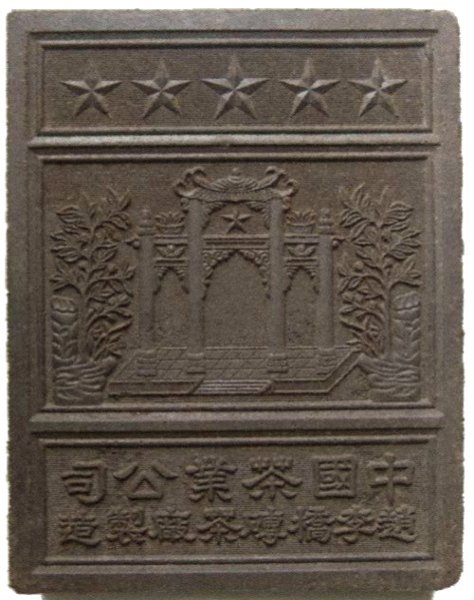
Several members of members of the Arcata Zen Group joined us and presented an information table. A gentleman is growing tea plants in his Eureka garden and wanted to learn more about tea culture and cultivation. Another gentleman who had just toured the visiting Lady Washington tallship bought a brick of tea on board, and brought it to show us and other guests. It looked just like this:

http://upload.wikimedia.org/wikipedia/commons/5/5b/BlackTeaBrick.jpg
Our gratitude is never-ending for the assistance of Laura and Pia and all of "Team Horai," who are vital to our mission and instrumental to our presentations. We also extend a special "thank you!" to Charlotte MacDonald of the Eureka Main Street organization for her assistance with organizing our demonstration. And most of all, we thank our warm and friendly guests, both old friends and new. Everyone who attended has our gratitude for making our demonstrations possible and creating connections by the sharing of tea.

Tuesday, March 20, 2012

Clay and Fire, Art and Experience

“The worst way to explain the Japanese tea ceremony is to have someone sit and watch it being done,” explained Harvey-sensei to a group of about 30 students, faculty and various community members who had come to watch a demonstration of the Japanese tea ceremony. “It seems like it takes 20 minutes to do, what? Make a cup of tea? The Tea Ceremony is not a spectator sport: You are meant to participate in it and experience it. But you can’t really participate unless you know how it’s done. So bear with me and just watch. We’ll answer questions in the next round.”

Silently, Laura and Annie entered the “tea room,” scooting in on their knees into a space defined by four and half tatami mats arranged in the middle of an art gallery and surrounded by seated spectators. After they settled, I entered the space and served a tray of sweets to Laura, the head guest.

Then the adrenaline hit.

There were 30 people watching, interested in seeing a performance of an esoteric art form that defies explanation, and I was nervous. My heart raced, my hands shook, my face felt flushed and warm. “Just like at home,”  I told myself “Just like at practice, no one but us three here in the tea room.” Didn’t work. Still nervous. Breathe. Just sit. Just make tea.

About halfway through the demonstration, as Laura was returning her empty bowl to me — a bowl that was lent to us by one of the pottery artists participating in West Coast Wood Fire for purposes of this demonstration —  I realized it was almost over and I didn’t want it to end. Laura scooted toward me with the bowl, stopped, then held it just above her knees. The colors of her kimono, the tatami and the bowl harmonized in warm, earthy tones — gold, olive, orange. She seemed to pause for a moment before setting it down, as if she knew what I was thinking, that too soon this would all be over and this brief, beautiful moment would be gone. The bowl would be washed and returned; we would not be able to use it again. The mats would be packed up and taken home. Our kimono folded, our memories fading. This was furyu, the perception of a transient moment of beauty that evaporates like steam from a kettle — and I could not demonstrate it to our audience. 

:: :: ::

This demonstration of cha-no-yu was held at College of the Redwoods in Eureka, Calif., in conjunciton with West Coast Wood Fire, a month long series of exhibits and events celebrating wood-fired ceramics and the cultures that surround them. (Read more here in a previous post.)

Harvey-Sensei, far left, discusses the tea ceremony with
students and instructors from College of the Redwoods
as well as members of the community.

Usucha-temae (thin tea ceremony) demonstrated by Holly
with guests Laura and Annie. Dave ZDrazil (in back, with camera)
and Shannon Sullivan (seated next to him)
were instrumental in arranging the demonstration.

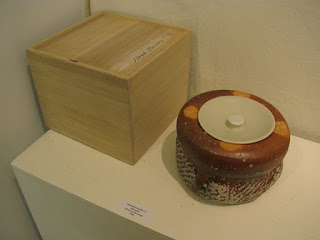
One of the exhibiting artists, Hank Murrow of Oregon, offered to let us use a chawan (bowl) and mizusashi  (cold water container) for our demonstration. Hank formulated the clay for his chawan to imitate the "Mogusa" clay used by potters of Mino, Japan. The clay, which has prominent grains of feldspar, prevents vitrification even at the high temperatures (cone 14) reached in the anagama kiln so the ware remains slightly porous, insulating and soft sounding like Raku. (His tea teacher in Tokyo, Mr. Koichi Okamoto, told him that the whisk should sound like "rain on thatch" rather than "rain on corrugated metal," as it would with fully vitrified wares such as porcelain.)

Chawan and mizusashi by Hank Murrow

Chawan by Hank Murrow

Mizusashi by Hank Murrow

This chawan, featuring his Shino glaze, was fired for 100 hours in the back of the anagama kiln and received little ash. The clay for the body of the mizusashi is also a special mix he uses for tea ware with large grains of feldspar but the contrasting lid is made of porcelain, inspired by the tradition of tea masters who used elegant materials for lids of their rustic pieces, such as Imari porcelain or lacquered wood (as Hank said, "18th century mix-and-match"). He had intended to gild the inside of the lid to prevent it from sliding around on the jar. There are  patches of Shino glaze on the four sides where there is a rope-like texture. He was concerned the porous clay would weep, but we encountered no such problem. 

Hank's pieces were fired in the Jewel Creek Anagama kiln in Sand Lake, Ore., in view of the Pacific Ocean.

We also used some pieces made by Dave Zdrazil, one of the coordinators of West Coast Wood Fire.

Kensui by Dave Zdrazil. He said he was inspired by seeing
kensui at a demonstration we performed last January.

Chawan by Dave Zdrazil. The stripes are created
by different types of clay.

Each guest enjoyed one of Annie's delicious homemade wagashi sweets — sweet mochi wrapped around delicately pink-tinted shiro-an — and a bowl of matcha. Many students brought their own chawan, as a special part of this demonstration was for them to be able to have tea in their own recently-crafted bowls.

Student work

Student work

Later in the evening, we attended two of the three gallery openings of West Coast Wood Fire at the Fire Arts Center and Ironside Gallery, both in Arcata, Calif. (the third gallery is in Eureka at Sewell Gallery). There were so many different and beautiful forms -- vases, cups, jars, decorative pieces and beautiful chawan.The pieces are on exhibit (and for sale!) through the end of March.

Here are Hank Murrow's chawan and mizusashi on display at Fire Arts Center:
 
Tea caddy and chawan by Hank Murrow
Mizusashi by Hank Murrow

For more about Dave, Shannon and Hank's work, visit:

Tuesday, February 14, 2012

West Coast Wood Fire: Ceramics Exhibits and Events

Chaire (tea container) and chawan (tea bowl) made by Hank Murrow of Oregon.

“West Coast Wood Fire” is a series of exhibits and events relating to wood fired ceramic art and the culture that surrounds it.  Two exhibits featuring contemporary wood fired ceramic pottery and sculpture by artists from California, Oregon and Washington will be held at the Fire Arts Center and Plaza Design in Arcata. Several world renowned clay artists are featured in the exhibits including three authors of ceramics books, several professors and professors emeriti. The works featured have unique surfaces and ash glazes which occur naturally from atmospheric conditions inside wood fired kilns, which are sometimes fired for up to 10 days at temperatures exceeding 2,300° Fahrenheit.  

A traditional Japanese Tea Ceremony demonstration will be presented by the Horai Center for the Study of Pacific Culture, taking place in the College of the Redwoods Creative Arts Gallery on March 9.  The tea ceremony will highlight the connection between Japanese culture and traditions to the aesthetics found in Japanese folk art and humble ceramic forms such as the chawan (tea bowl).  Japanese folk art (mingei) and wabi-sabi aesthetic has been very influential amongst Western ceramicists who have traveled to Japan to learn their craft, especially in the context of wood fired stoneware and porcelain.  [UPDATE: Location Map]


The College of the Redwoods ceramics department will host guest ceramic artist Terry Inokuma (Oregon) for a two day ceramics presentation and demonstration of her techniques.  Ceramic artist Richard Hotchkiss will also be presenting a short documentary film, “The Climbing Kiln of Woolman Lane” which features a three day wood firing workshop at his kiln in Nevada City, California.  The six chambered kiln is the largest and oldest wood fired climbing kiln in North America and has provided a wood firing experience to thousands of ceramic artists since 1971.

The process of firing ceramics with wood dwindled with the advent of the industrial revolution and following technologies but has carried on through particular facets of tradition and aesthetic.  This labor intensive process usually requires a cooperative effort amongst participants for a successful outcome.  This idea of community is what has inspired “West Coast Wood Fire” and other events like it around the world.  

Thursday and Friday, February 23  and 24, 10a.m. – 3p.m.
College of the Redwoods hosts guest ceramic artist Terry Inokuma (Oregon).
Creative Arts room 136

Friday, February 24, 9 a.m.:
Richard Hotchkiss will give a guest lecture and present the documentary “The Climbing Kiln of Woolman Lane” which features his wood-fired kiln during a 3 day workshop.
College of the Redwoods, Creative Arts room 139
  
Friday, March 9, 1p.m.
Tea Ceremony Demonstration by the Horai Center for the Study of Pacific Culture held in the Creative Arts Gallery at College of the Redwoods, horai.center@gmail.com

March 2- 31 “West Coast Wood Fire”
Fire Arts Center, 520 S. G. Street, Arcata. www.fireartsarcata.com.
Opening Reception Friday March 9
, 6-8pm (During Arts! Arcata)

Artists include: Mike Beebe (CA,)John Benn (WA) Doug Browe (CA), Rhue Bruggeman (CA), Conrad Calimpong (CA), Richard Carter  (CA), Bonita Cohn (CA), Thomas Fossier (CA), Colleen Gallagher (WA), Bill Geisinger (CA), Kathy Guss (WA,)Colinda Gutierrez (CA),Rod Guyer (CA), Chuck Hindes (WA), Sam Hoffman (OR), Richard Hotchkiss (CA), Glenn  Husted (CA), Terry Inokuma (OR), Lisa Jetonne (CA), Kathy Kearns (CA),  Nils Lou (OR), , Marc Lancet (CA), Diane Levinson (CA), Ron Linn (OR),), Hank Murrow (OR), Fred Olsen (CA), Hiroshi Ogawa (OR),Reid Ozaki (WA), Scott Parady (CA), , Kenneth Pincus (OR), Stephen Robison  (WA),Andy Ruble (CA),  Monique Rutherford (CA), Steve Sauer (WA), Nick Schwartz (CA), Tim Steele (OR), Jules Stout (CA), Al Tennant (WA), Mark Terry  (OR), Mila Visser 't Hooft (CA), Jon Weil (CA) , Jay Widmer (OR),  David Zdrazil (CA)

March 1 – April 30 “West Coast Wood Fire Local Artists”
Plaza Design, 808 G. Street, Arcata. http://www.plazad.com/


The original venue (Plaza Design) for local artists is closing. There are two new venues:

March 1 – April 30 “West Coast Wood Fire Local Artists”
Sewell Gallery, 423 F Street, Eureka. www.sewellgallery.com
Opening Reception Saturday, March 3rd, 6-9 p.m. (During Arts Alive)
Hours: Tuesday – Saturday 10 a.m. – 6 p.m.
            Sunday, Noon – 5 p.m.

March 1 – 30 “West Coast Wood Fire Local Artists”
Ironside Gallery, 900, 9th Street, Arcata. http://ironsidegallery.com/category/home-page/
Opening Reception Friday, March 9th, 6-9 p.m.  (During Arts! Arcata)
Hours: Tuesday- Thursday 11 a.m. – 4 p.m.
            Friday & Saturday 11 a.m. – 7 p.m.


Artists include: Conrad Calimpong, Darcy Casagrande, Honoree Cress, Jessica Eden, Rebecca Degagne, Stephen Faletta, Keith Fleury, Thomas Fossier, Ben Freund, David Jordan, Karl Klingenspor,  Peggy Loudon,  Matthew Meil, Scott North, Bob Raymond, Elaine Shore, Shannon Sullivan, Margaret Whitcomb, David Zdrazil

For information, contact Dave Zdrazil at 940-206-5523 or davezdrazil@yahoo.com

:: :: ::

For more, read The Wildness of Natural Process: Wood-fired ceramics and "West Coast Wood Fire" by Jason Marak for the North Coast Journal.

Friday, January 20, 2012

Tea Ceremony Demonstration, Jan. 2012


We welcomed 17 people to the Ink People Center for the Arts for our first demonstration of 2012. We demonstrated ro-usucha-temae.  

Harvey-sensei welcomes our guests and gives them an introduction to Cha-no-yu.


Pia and Kristin working hard in the mizuya
After the demonstration, Pia, Kristin and I quickly made many bowls of tea in the mizuya and took turns taking them out to guests while Harvey answered questions about procedure, equipment, culture. My favorite question was from a self-posessed pre-teen who asked, "What is your position on Lemon Zinger?" As she left, she commented to her mother that she had a great time.

If weather permits, we will enjoy cherry blossom viewing at our next demonstration.

Wednesday, July 27, 2011

July Tea Ceremony Demonstration


In July, we demonstrated chabako for a small but appreciative audience. Since the ceremony is meant to be performed outdoors, chabako is affectionately known as "picnic tea" but we routinely practice the procedure indoors.

We were able to enjoy chabako outdoors several times last year. I hope we have a chance to have tea outdoors soon, before summer ends.

Thursday, July 7, 2011

June Tea Demonstration

Our June Tea Ceremony demonstration of furo usucha was for three lovely people, one of whom studies chado with the sensei of a mutual friend in the Omotesenke school (we study Urasenke style). As is usual, Harvey-sensei narrated and answered questions while we students demonstrated the temae.

As I brought in the utensils to do the demonstration, I realized we had forgotten to place a tea scoop on the bowl so I brought it in with the kensui (waste-water bowl) and hishaku (water ladle) -- kensui and hishaku in left hand as usual, but with the scoop alone in my right hand (normally the tea bowl, whisk, scoop and chakin -- a small linen cloth -- are brought in together with the tea container ahead of the kensui). After the demonstration, our guest asked if it was customary in the Urasenke tradition to bring in the scoop in that fashion. We all had a good laugh at our mistake!


Chabana in a sake bottle: veronica, cotoneaster,
ornamental oregano, buttercup and miniature rhododendron

Wednesday, May 25, 2011

Tea Demo, May 22

On Sunday we hosted eight lovely guests at the Ink People Center for the Arts for a lively tea ceremony demonstration.

First, Harvey-sensei demonstrated furo-usucha, with Holly and area potter Thomas Fossier as okyaku, then Holly made usucha for other guests -- two at a time -- while Harvey answered questions. It was lovely to see familiar faces and meet interesting new people.

The highlight of the day was Thomas' new chawan, fresh from a firing in Oregon last month. He's in the process of building his own kiln, which means  (we hope!) that we'll be seeing more of his beautiful work.


Chawan made by Humboldt County potter, Thomas Fossier

We used roll-up mats for our 'chashitsu' --
lightweight and portable, but impossibly wrinkly

Information table and chabana