Showing posts with label art. Show all posts

Sunday, November 27, 2016

Imōto (Sister): Sister City Exhibit

Kashima Jingu Ichi no Torii
Imōto (Sister), an exhibit of photos of Kamisu, Japan, Eureka's Sister City, by Holly Harvey and the Horai Center at Studio 424, 424 Third Street, Eureka. An opening reception will be held during Arts Alive!, Dec. 3,  2016 from 6-9 p.m. The exhibit and opening are a fundraiser for the Sister City Association, and a portion of gallery sales will benefit the association.

About the show

Some words for familial relationships in the Japanese language are relative (no pun intended). There are unique words, for example, to describe the relationships within your family that are different from the words used to describe the relationships between someone else's family. Likewise, the words for sister are linked to the age of the individuals, with unique words for older and younger sisters. Ane 姉 means older sister and imōto 妹 means younger sister.

Eureka and its sister city of Kamisu, Japan, have a similarly complicated relationship. Based on the age of each city, Kamisu should be the older having been settled as a village since before Japan’s Middle Ages (Eureka was incorporated a city in 1874). However, the modern city of Kamisu was formed in 2005 by a merger of the former town of Kamisu and the neighboring town of Hasaki. As such it is a little older than ten years, making it the younger of the two.

The city commemorated its 2005 incorporation with a ceremony in August of 2015. It invited its Sister City Eureka to attend, and Harvey II and Holly Harvey of the Ink People’s DreamMaker program Horai Center represented the City of Eureka at the ceremony. The photographs in this exhibit were taken during a brief introduction to Kamisu’s people, her industry, natural beauty and cultural treasures. The contrast of the ancient and the modern was a source of constant fascination.

You may view the exhibit in an online gallery here.

Mounted prints are $75.00 each. A portion of the proceeds from this exhibit benefit the Eureka-Kamisu Sister City Association. Inquiries for additional prints are welcomed. (Obi are for display only and are not for sale.)

About Kamisu

Kamisu is port city with a population of 93,550 about 55 miles northeast of Tokyo. Kamisu and the surrounding area is considered rural by Japanese standards. Originally a fishing and farming region, it has grown rapidly in the years following World War II. It is home to one of the world’s largest artificially-created deep water ports in Asia, and because of its proximity to Tokyo it is ideally situated for the region’s cargo shipping, light and heavy industry, power generation and clean energy development. The region is still renowned for its agriculture, especially green bell peppers, or piman, which are shipped fresh daily to Tokyo. Despite modernization and trending industry — and perhaps because of it — the people of Kamisu cherish their cultural heritage and natural resources.

Relationships are fragile, complicated things. We are born into them as infants. We create new ones with each person we meet. We try to end them with a mouse click. Taken for granted, relationships languish. Given attention, they may flourish.

About the Eureka-Kamisu Sister City Association

The EKSCA works to maintain the sister city relationship and to foster cultural exchange and mutual understanding between the citizens of the two cities. It is developing a network for, student exchanges and family home stays. For more information, visit www.eureka-kamisu.org or connect with us on Facebook, www.facebook.com/EKSCA.


The Horai Center is a DreamMaker Program of the Ink People Center for the Arts.

Updated Dec. 9, 2016

Monday, June 10, 2013

'Give it Over To The Fire'

Pottery by Dave Zdrazil

Humboldt County artists open their studios to the public for North Coast Open Studios on the first two weekends in June. This is an annual "must-do" for us.

We usually make a long day of it, visiting as many studios as we can pack in. This year we were limited to just a single day, so we pared our list down to two husband/wife studios: Lorraine Lindley and Mark Young, and Shannon Sullivan and Dave Zdrazil. Mark and Dave's styles are very different, but their pottery is clearly influenced by a Japanese aesthetic. After visiting with these wonderful artists, I wrote a post for the North Coast Journal about our studio tours, 'Give it Over To The Fire.' More photos there too!


Wednesday, February 13, 2013

Calligraphy Workshop: Tai Ji and Qi Gong in Motion

Pearl Weng-Liang Huang

Presented by guest artist Pearl Weng-Liang Huang.

Saturday, March 30, 2013
10:00 a.m.-3:30 p.m.
D Street Neighborhood Center, Arcata
[Directions/Location]

Registration: Contact All Under Heaven, (707) 825-7760
$50 Enroll by March 15
$65 Drop in day of workshop
$5 for discount with Student ID
Cost includes all art supplies needed for class. No previous experience needed.

Chinese Folktale Storytelling with Pearl Weng Liang Huang

Meet Pearl for an evening of sharing and reading folk stories from her childhood in Chinese and English. Free and open to the public.

Friday, March 29, 2013
6:00 p.m.
Goodwin Forum (Nelson Hall)
Humboldt State University
[Location]

About the artist

Pearl Weng Liang Huang will introduce the concept and method of working with brush and ink as a form of moving meditation. Group and individual participation will integrate the practice of chinese calligraphy with Tai Ji and Qi Gong.

Born in China, and trained in Chinese calligraphy, music and the arts, Pearl's life long practice of brush calligraphy as Tai Ji/Qi Gong moving meditation is the tradition of her family’s Living Tao Tai Ji form, and the teachings of her elder brother, Tai Ji Master, Chungliang Al Huang.
“Qi Gong is life force, and Tai Ji movement is the living form of life’s dance harmonizing with nature. Chinese brush calligraphy is Tai Ji and Qi Gong in motion, which can enhance our energy and maintain physical, emotional and spiritual balance.”
Many of the original forms and spiritual meanings of the powerful images of Chinese written language have sustained throughout the ages. Learning to create the symbols of the Chinese language through brush calligraphy is not only an aesthetic expression; it is also a way of life. It can express beauty, emotion, and primordial life force. Practicing Chinese calligraphy is a meditation for us to harmonize with nature and the Dao.

Pearl lives in Taos, New Mexico and offers classes and workshops in her studio, Ru Yi. For more information: www.ruyistudio.com or the HSU APASA Site: http://agoile.wix.com/pan-ap

This workshop is sponsored by All Under Heaven and is being presented in conjunction with Humboldt State University's Asian Pacific Islander American Student Alliance. This and other events are part of a weeklong festival March 25-30, 2013.

Tuesday, April 10, 2012

"Colorful Realm" on exhibit at the National Gallery of Art

Seeing news of this exhibit on PBS's Newshour last night left me speechless.

Silk painting by Ito Jakuchu, http://www.nga.gov/
Celebrating the centennial of Japan's gift of cherry trees to the nation's capital, this exhibition features one of Japan's most renowned cultural treasures, the 30-scroll set of bird-and-flower paintings by Itō Jakuchū. Titled Colorful Realm of Living Beings (J. Dōshoku sai-e; c. 1757–1766), these extraordinary scrolls are being lent to the National Gallery of Art by the Imperial Household. Their exhibition here—for one month only—provides a unique, once-in-a-lifetime opportunity: not only is it the first time all 30 paintings will be on view in the United States, but it is also the first time any of the works will be seen here after their six-year-long restoration.
  
The collection of paintings — animals, flowers, insects, together with a Shakyamuni tryptich — represents the Buddha teaching all creation. It reminded me of Elizbeth Coastworth book, The Cat Who Went to Heaven, wherein a painter is commissioned to create an image of the Buddha for a temple and in order to do so he paints a series of animals that were Buddha's previous incarnations. Visit the Newshour's website to see more of Jakuchu's remarkable paintings.

Colorful Realm: Japanese Bird-and-Flower Paintings by Itō Jakuchū will be on exhibit at the National Gallery of Art in Washington, D.C., from March 30 through April 29, 2012.

Tuesday, March 20, 2012

Clay and Fire, Art and Experience

“The worst way to explain the Japanese tea ceremony is to have someone sit and watch it being done,” explained Harvey-sensei to a group of about 30 students, faculty and various community members who had come to watch a demonstration of the Japanese tea ceremony. “It seems like it takes 20 minutes to do, what? Make a cup of tea? The Tea Ceremony is not a spectator sport: You are meant to participate in it and experience it. But you can’t really participate unless you know how it’s done. So bear with me and just watch. We’ll answer questions in the next round.”

Silently, Laura and Annie entered the “tea room,” scooting in on their knees into a space defined by four and half tatami mats arranged in the middle of an art gallery and surrounded by seated spectators. After they settled, I entered the space and served a tray of sweets to Laura, the head guest.

Then the adrenaline hit.

There were 30 people watching, interested in seeing a performance of an esoteric art form that defies explanation, and I was nervous. My heart raced, my hands shook, my face felt flushed and warm. “Just like at home,”  I told myself “Just like at practice, no one but us three here in the tea room.” Didn’t work. Still nervous. Breathe. Just sit. Just make tea.

About halfway through the demonstration, as Laura was returning her empty bowl to me — a bowl that was lent to us by one of the pottery artists participating in West Coast Wood Fire for purposes of this demonstration —  I realized it was almost over and I didn’t want it to end. Laura scooted toward me with the bowl, stopped, then held it just above her knees. The colors of her kimono, the tatami and the bowl harmonized in warm, earthy tones — gold, olive, orange. She seemed to pause for a moment before setting it down, as if she knew what I was thinking, that too soon this would all be over and this brief, beautiful moment would be gone. The bowl would be washed and returned; we would not be able to use it again. The mats would be packed up and taken home. Our kimono folded, our memories fading. This was furyu, the perception of a transient moment of beauty that evaporates like steam from a kettle — and I could not demonstrate it to our audience. 

:: :: ::

This demonstration of cha-no-yu was held at College of the Redwoods in Eureka, Calif., in conjunciton with West Coast Wood Fire, a month long series of exhibits and events celebrating wood-fired ceramics and the cultures that surround them. (Read more here in a previous post.)

Harvey-Sensei, far left, discusses the tea ceremony with
students and instructors from College of the Redwoods
as well as members of the community.

Usucha-temae (thin tea ceremony) demonstrated by Holly
with guests Laura and Annie. Dave ZDrazil (in back, with camera)
and Shannon Sullivan (seated next to him)
were instrumental in arranging the demonstration.

One of the exhibiting artists, Hank Murrow of Oregon, offered to let us use a chawan (bowl) and mizusashi  (cold water container) for our demonstration. Hank formulated the clay for his chawan to imitate the "Mogusa" clay used by potters of Mino, Japan. The clay, which has prominent grains of feldspar, prevents vitrification even at the high temperatures (cone 14) reached in the anagama kiln so the ware remains slightly porous, insulating and soft sounding like Raku. (His tea teacher in Tokyo, Mr. Koichi Okamoto, told him that the whisk should sound like "rain on thatch" rather than "rain on corrugated metal," as it would with fully vitrified wares such as porcelain.)

Chawan and mizusashi by Hank Murrow

Chawan by Hank Murrow

Mizusashi by Hank Murrow

This chawan, featuring his Shino glaze, was fired for 100 hours in the back of the anagama kiln and received little ash. The clay for the body of the mizusashi is also a special mix he uses for tea ware with large grains of feldspar but the contrasting lid is made of porcelain, inspired by the tradition of tea masters who used elegant materials for lids of their rustic pieces, such as Imari porcelain or lacquered wood (as Hank said, "18th century mix-and-match"). He had intended to gild the inside of the lid to prevent it from sliding around on the jar. There are  patches of Shino glaze on the four sides where there is a rope-like texture. He was concerned the porous clay would weep, but we encountered no such problem. 

Hank's pieces were fired in the Jewel Creek Anagama kiln in Sand Lake, Ore., in view of the Pacific Ocean.

We also used some pieces made by Dave Zdrazil, one of the coordinators of West Coast Wood Fire.

Kensui by Dave Zdrazil. He said he was inspired by seeing
kensui at a demonstration we performed last January.

Chawan by Dave Zdrazil. The stripes are created
by different types of clay.

Each guest enjoyed one of Annie's delicious homemade wagashi sweets — sweet mochi wrapped around delicately pink-tinted shiro-an — and a bowl of matcha. Many students brought their own chawan, as a special part of this demonstration was for them to be able to have tea in their own recently-crafted bowls.

Student work

Student work

Later in the evening, we attended two of the three gallery openings of West Coast Wood Fire at the Fire Arts Center and Ironside Gallery, both in Arcata, Calif. (the third gallery is in Eureka at Sewell Gallery). There were so many different and beautiful forms -- vases, cups, jars, decorative pieces and beautiful chawan.The pieces are on exhibit (and for sale!) through the end of March.

Here are Hank Murrow's chawan and mizusashi on display at Fire Arts Center:
 
Tea caddy and chawan by Hank Murrow
Mizusashi by Hank Murrow

For more about Dave, Shannon and Hank's work, visit:

Thursday, March 1, 2012

Nuclear Flowers

Christoph Niemann’s cover illustration,
"Dark Spring," for the March 28, 2011
edition of The New Yorker magazine

 “It’s very tricky to do any drawing of a tragedy,” said Christoph Niemann, who created “Dark Spring,” this week’s cover. When asked to come up with an image about the series of disasters that have hit Japan, he was hesitant. “A drawing often comes across as lighthearted, and there’s obviously nothing lighthearted about this thing.” 

Read the full story at http://www.newyorker.com/online/blogs/newsdesk/2011/03/cover-story-christoph-niemann-japan-earthquake.html

Sunday, February 26, 2012

West Coast Wood Fire Ceramic Artist Exhibitions

UPDATE FEB. 28


March 2- 31 “West Coast Wood Fire”
Fire Arts Center, 520 S. G. Street, Arcata. www.fireartsarcata.com
Opening Reception Friday March 9th, 6-8pm (During Arts! Arcata)
Hours: Monday-Friday 9-5 and by appointment
Phone #: 707-826-1445

Artists include: Mike Beebe (CA,)John Benn (WA), Doug Browe (CA), Rhue Bruggeman (CA), Conrad Calimpong (CA), Richard Carter (CA), Bonita Cohn (CA), Thomas Fossier (CA), Colleen Gallagher (WA), Bill Geisinger (CA), Kathy Guss (WA,)Colinda Gutierrez (CA),Rod Guyer (CA), Chuck Hindes (WA), Sam Hoffman (OR), Richard Hotchkiss (CA), Glenn Husted (CA), Terry Inokuma (OR), Lisa Jetonne (CA), Kathy Kearns (CA), Nils Lou (OR), , Marc Lancet (CA), Diane Levinson (CA), Ron Linn (OR),), Hank Murrow (OR), Fred Olsen (CA), Hiroshi Ogawa (OR),Reid Ozaki (WA), Scott Parady (CA), , Kenneth Pincus (OR), Stephen Robison (WA),Andy Ruble (CA), Monique Rutherford (CA), Steve Sauer (WA), Nick Schwartz (CA), Tim Steele (OR), Jules Stout (CA), Al Tennant (WA), Mark Terry (OR), Mila Visser ‘t Hooft (CA), Jon Weil (CA) , Jay Widmer (OR), David Zdrazil (CA)

The original venue (Plaza Design) for local artists is closing. There are two new venues:

March 1 – April 30 “West Coast Wood Fire Local Artists”
Sewell Gallery, 423 F Street, Eureka. www.sewellgallery.com
Opening Reception Saturday, March 3rd, 6-9 p.m. (During Arts Alive)
Hours: Tuesday – Saturday 10 a.m. – 6 p.m.
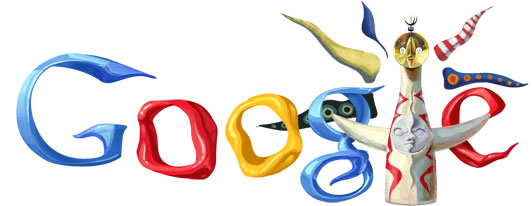
            Sunday, Noon – 5 p.m.

March 1 – 30 “West Coast Wood Fire Local Artists”
Ironside Gallery, 900, 9th Street, Arcata. http://ironsidegallery.com/category/home-page/
Opening Reception Friday, March 9th, 6-9 p.m.  (During Arts! Arcata)
Hours: Tuesday- Thursday 11 a.m. – 4 p.m.
            Friday & Saturday 11 a.m. – 7 p.m.

Artists include: Conrad Calimpong, Darcy Casagrande, Honoree Cress, Jessica Eden, Rebecca Degagne, Stephen Faletta, Keith Fleury, Thomas Fossier, Ben Freund, David Jordan, Karl Klingenspor, Peggy Loudon, Matthew Meil, Noel Munn, Scott North, Bob Raymond, Elaine Shore, Shannon Sullivan, Margaret Whitcomb, David Zdrazil

Read more about the exhibits and events at davezdrazil.com/blog/

Tuesday, February 21, 2012

Twice As Nice

Rich Paselk, a long-time friend and Chanoyu booster, shared with us this charming stereoscopic photo from his collection titled "1001. Japanese Girls at a Tea House." 

1001. Japanese Girls at a Tea House

Detail
I was interested to see what other historic photos of Japan I could find and a Google search first took me to this site, http://pinktentacle.com/2009/10/animated-stereoviews-of-old-japan. (They're beautiful, but I'll warn you — the animations made me a little seasick.) Following a link beneath the photos will take you to this Flickr page, 309 images of Old Japan in 3D. Enjoy!

Tuesday, January 24, 2012

Happy Year of the Dragon!

Omizuya (water house), detail
Toshogu Shrine, Nikko, Japan

Friday, January 13, 2012

The 53 Stations of the Tōkaidō

"Numazu"


Thirteen prints from Hiroshige's famous series of woodblock prints, "The 53 Stations of the Tōkaidō," are on display at the Morris Graves Museum of Art in Eureka, Calif. The exhibit, which is in the Youth Gallery, is aimed at educating young people about Japanese history and culture with maps and timelines, a biography of Andō Hiroshige, and explanations of how the prints were created. Each print is accompanied by a facsimile of the wood block and a poster detailing features of the print, such as the landscape, weather or articles of clothing.

The exhibit will be on display through February 26, 2012.

The Morris Graves Museum of art is located at 636 F Street, Eureka, Calif. Open Wed. through Sunday, noon to 5:00 p.m. An admission donation of $4.00 is suggested, but admission to the museum is free during Arts Alive!, February 4, from 6:00-9:00 p.m. For more information, call (707) 442-0278.

Sunday, September 4, 2011

Ganbare Nihon! Media Exhibit

We attended the exhibit of the Ganbare Nihon! tsunami relief project this weekend. The photographs and multimedia presentation were incredibly moving.


Coordinator Fukiko Marshall and journalism student
Ashley Ward speak with guests at the exhibit.
This show will be up only from Sept. 2–7 at the Vance Hotel, 521 2nd Street (corner of Second and G streets) in Eureka's Old Town from 11:30 a.m.– 7 p.m.

Tuesday, August 30, 2011

The Ganbare Nihon Project


Ganbare Nihon! is a media exhibition of tsunami disaster/relief in Japan. The exhibit features photos and videos by Fukiko Marshall and three students from Humboldt State University who traveled to Japan last spring.

This show will be up only for a short time
from Sept. 2–7 at the Vance Hotel, 521 2nd Street, in Eureka's Old Town from 11:30 a.m.– 7 p.m. The opening reception is during Arts Alive! Saturday Sept. 3, 6–9:00 p.m. 

Read more >> http://now.humboldt.edu/news/student-journeys-to-japan-to-cover-aftermath-of-mega-disaster/

Wednesday, August 10, 2011

Putting Together


Ever get the feeling that somebody is sending you a message? In the space of a week, Harvey found these passages in books he was reading:

When Coleridge tried to define beauty, he returned always to one deep thought; beauty, he said, is unity in variety! Science is nothing else than the search to discover unity in the wild variety of nature, — or, more exactly, in the variety of our experience. Poetry, painting, the arts are the same search, in Coleridge’s phrase, for unity in variety.

— J. Bronowski, Science and Human Values, Pelican 1964


All design is synthesis — composition — the putting of forms together so that they conform to a demand which is made by the eye and the mind. Why this demand is made by the eye and the mind it will not profit us to inquire. But the demand asserts itself at every turn in life’s affairs. It is based upon some adoration of Order amongst Variety.
All people arrange things in orderly fashion. To do so is one of the most general of human actions. People can therefore be trusted, when they arrange, to arrange orderly.
Design is conscious arrangement. Spite of the objection that it sure to be raised by those critics who, not being producers, delight to find some paradoxical impasse to block the efforts of others — spite of their complaint that art must be artless, one repeats, what every productive artist knows, that design is conscious arrangement.

— Richard G. Hatton, The Craftsmen’s Plant-Book, 1909. Republished as Handbook of Plant and Floral Ornament from Early Herbals, Dover Publications 1960.

Toriawase means "taking and putting together." It is a guiding principle in many Japanese arts. For example, in haiku the poet attempts to unite two themes separated by kireji or a "cutting word." In chado, the host strives to put together utensils in such a way that, however different in appearance or mood, they unite in harmony without repetition or artifice.

Sunday, July 10, 2011

Chop Wood, Fire Pottery

It's an apparently simple process: chop wood, boil water, make tea. Tea bowls also appear simple, but we learned recently their simplicity belies their making.

We met pottery artist Thomas Fossier a couple years ago at an arts and crafts fair, and were quite taken by his tea bowls. We struck up a conversation, shared anecdotes about travel in Japan and invited him to learn about Tea with us. One of our friends bought a bowl from him at that craft fair, and several of us went in together on a bowl to give to our Sensei in Japan when we visited her last spring.

Thomas brought several tea bowls to our May Tea Ceremony demonstration fresh from a firing at a friend's kiln in Oregon. The bowls were lovely, and it was wonderful to be able to share tea with the artist and his creation. Thomas told us he was building a kiln of his own, and invited us to come see it when it was finished. The type of kiln he was building is anagama, the traditional wood-fired kiln of Japan. (Wikipedia has a much better explanation than I could write, http://en.wikipedia.org/wiki/Anagama_kiln.) Typical anagama kilns have a single chamber; Thomas designed his with two chambers, the upper chamber at a right angle to the lower chamber. Stoking the fire is done primarily through the lower chamber.

Thomas Fossier's kiln
Last weekend we got a message that he was firing up his kiln. He began firing early on a Friday morning. When we arrived around 6:00 that evening the kiln was glowing merrily.


Pots can be seen glowing inside the kiln
as wood is added "shotgun style" to the firebox.
We thought it looked merry, but that wasn't necessarily the case. Thomas had been struggling with the kiln all day. He explained that when he began firing that morning, the weather was cool and overcast, even a little foggy, and the kiln temperatures climbed as expected each time he stoked the firebox. But kiln temperatures plateaued as the day warmed, skies cleared and the fog burned off. It seemed that no matter what variety or how much wood was fed into the firebox temperatures hovered, climbing or dropping by a few degrees, but not even approaching the 1400°C that was needed to fire the pottery and create the surface glazing and textures he desired.

The reason? Thomas theorized that it might have been high barometric pressure, or "thick air" as he characterized it, kept the kiln from drawing in air and starved the fire of oxygen. Regardless, in the two hours we spent with him the kiln's temperature hovered around 750°C, never making the dramatic leaps of temperature he anticipated with each stoking.

Thomas and his friend Scott, also a pottery artist,
stoke the firebox with scrap wood from local
musical instrument makers.
Scott and Thomas' wife Suzanne watch
for smoke from the chimney -- a sign
that the kiln is drawing properly.
Thermometers register cool temperatures from
rear (top thermometer) and front chambers


The next morning we received an email that Thomas ended his firing at 7:00 that morning, "having gotten just above red heat throughout the kiln and too exhausted to go any farther." He never really figured out the problem but chalked it up to the learning curve. What will he do with the half-fired pottery? Most likely he'll close up the kiln, cover up the firewood and wait till autumn and cooler weather.

Thursday, April 28, 2011

Google Doodles

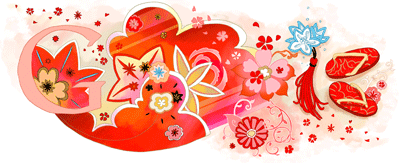
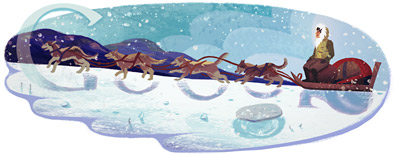
Google.com celebrates significant anniversaries and holidays from around the world with Google Doodles. Here are some we collected from earlier this year.

Mar 03, 2011 Girl's Day - (Japan)


Feb 28, 2011 Li Bai's Birthday - (China, Hong Kong, Taiwan)


Feb 26, 2011 100th Birthday of Taro Okamoto - (Japan)


Feb 17, 2011 Lantern Festival - (China, Hong Kong, Taiwan)


Feb 12, 2011 Naomi Uemura's 70th Birthday - (Japan)


Feb 03, 2011 Lunar New Year's - (China, Hong Kong, Korea, Taiwan)


Jan 20, 2011 Birthday of Takayanagi Kenjiro - (Japan)


Jan 10, 2011 Coming of Age Day - (Japan)

Friday, January 14, 2011

Artware Affair 2011

The Ink People Center for the Arts -- ardent sponsor of fledgling arts organizations such as our own Horai Center -- had it tough in 2010. A magnitude 6.5 earthquake on Jan. 9, 2010, damaged the city-owned building that housed the Inker's offices and galleries. Officials yellow-tagged the building, and Inkers found haven in a suite of offices leased to the Northern California Indian Development Council.

The Artware Affair is an important fundraising events for The Ink People but this year it seems to have more importance in light of the burden of increased financial hardships. Hardships never put a damper on a good Ink People party, so vamos a guarachar!

2011 Artware Affair ~ HAVANA NIGHTS
Saturday, January 29, 2011 - 5 to 10pm
Wharfinger Building, Eureka, Calif.
Un saludo carinoso!

Please join us for our 2011 gala celebration: HAVANA NIGHTS. The evening will be filled with exciting entertainment by the amazing HSU Afro-Cuban Club, fabulous food, decadent desserts and, of course, an incredible auction from local artists. This great event usually held in March is now January 29th... we hope you will mark your calendars. As they say, "Vamos a guarachar!" (Let's enjoy!)

Artists have big dreams. When these dreams benefit our community, The Ink People Center for the Arts is there to help make them happen!

This amazing evening will include live and silent art auctions featuring the work of many top artists of the North Coast, entertainment by The HSU Afro-Cuban Club and Bailarmos Salsa Dancers, mouth-watering food by Ms. M's Catering and a delightful themed Dessert As Art competition. Tickets are only $40 and a table of 8 may be reserved for just $280.
For more information, contact The Ink People at 442-8413 or Shoshanna at 616-6876.
We would love to invite artists to participate in this years' celebration... contact Shoshanna if you are interested!

Cigar Box Transformations

Artist-transformed cigar boxes will be auctioned for this year's Artware Affair -- and Holly Harvey of Horai Center made a contribution. This cigar box, titled "Bamboo," was inspired by Japanese maki-e or lacquerware. On display through the month of January at the Ink People's alternative gallery at Eureka's Adorni Center.

Before...

... and after! Click to enlarge.

Thursday, December 2, 2010

Gamelan Sekar Sequoia Performs in Arcata

Did you miss Gamelan Sekar Sequoia at November's Arts Alive! in Eureka? Fear not! Fill your ears with Gamelan goodness at Global Village, 973 H St., Arcata (one block off the Plaza), Friday, Dec. 17 from 6:30-8:30 p.m. FREE!

Friday, November 5, 2010

Gamelan Performance During Eureka Arts Alive!


Eureka's monthly arts night, Arts Alive!, is a remarkable showcase for the area's diverse artistic talents. In May, we stumbled upon a performance by Gamelan Sekar Sequoia (pictured above), a community-based gamelan ensemble. If you're unfamiliar with this traditional Indonesian music, search YouTube.com take a listen: it's percussive, melodic and magical. Live gamelan music is a special treat. 

Gamelan Sekar Sequoia will treat your ears with a free live performance during Arts Alive! Saturday, Nov. 6, 6-9 p.m. at Indah Bali, 440 F St., Eureka.

For more information about Arts Alive! call 707-442-9054.

Sunday, August 9, 2009

Sensu

I found a beautiful photo and culture blog and had to share this link about the use of sensu in Tea Ceremony.

Kyoto Daily Photo: Another purpose of sensu, paper fun

Take time to enjoy other posts and photos.

Sunday, July 26, 2009

Bakumatsu koshashin

You have a photo of yourself in kimono, perhaps meandering the roji, and you say to yourself, "I sure wish I could make make my photos look like they're from the Meiji era!" Well now you can, with the amazing Bakumatsu Koshashin!

http://labs.wanokoto.jp/olds

Just upload your photo then click the button to see yourself transported back in time!

After you've converted your entire iPhoto library, take a look at this Japanese language blog, http://www.tofugu.com/ It's where Harvey originally found Bakumatsu Koshashin. The rest of the site is interesting.