Tuesday, April 24, 2012

Buddhist Relics World Tour

Hiroshima, Japan. Los Angeles. Even little towns in rural northern California like Arcata. Sacred relics of Buddhism are on the road and coming to a town near you.


The Maitreya Project Relic Tour brings holy relics of the Buddha (the Buddha?) and Buddhist masters to cities worldwide in order to share loving kindness:
A unique and precious collection of more than 1,000 sacred Buddhist relics will be permanently displayed in the Heart Shrine of the completed Maitreya Buddha statue in Kushinagar. Meanwhile, it is the wish of the Spiritual Director of the Maitreya Project, Lama Zopa Rinpoche, that the collection should travel throughout the world to bring the blessings of the relics and the message of loving-kindness to people everywhere.

The relics will be in Arcata, Calif., April 27-29, 2012, at the Veteran's Memorial Building 1425 J Street. Opening ceremony is Friday from 6-8 p.m. Blessings will be offered all day and admission is free.

Buddhist holy relics may stop in your town! Visit maitreyaproject.org and click on "Relic Tour" for more information.

Tuesday, April 10, 2012

"Colorful Realm" on exhibit at the National Gallery of Art

Seeing news of this exhibit on PBS's Newshour last night left me speechless.

Silk painting by Ito Jakuchu, http://www.nga.gov/
Celebrating the centennial of Japan's gift of cherry trees to the nation's capital, this exhibition features one of Japan's most renowned cultural treasures, the 30-scroll set of bird-and-flower paintings by Itō Jakuchū. Titled Colorful Realm of Living Beings (J. Dōshoku sai-e; c. 1757–1766), these extraordinary scrolls are being lent to the National Gallery of Art by the Imperial Household. Their exhibition here—for one month only—provides a unique, once-in-a-lifetime opportunity: not only is it the first time all 30 paintings will be on view in the United States, but it is also the first time any of the works will be seen here after their six-year-long restoration.
  
The collection of paintings — animals, flowers, insects, together with a Shakyamuni tryptich — represents the Buddha teaching all creation. It reminded me of Elizbeth Coastworth book, The Cat Who Went to Heaven, wherein a painter is commissioned to create an image of the Buddha for a temple and in order to do so he paints a series of animals that were Buddha's previous incarnations. Visit the Newshour's website to see more of Jakuchu's remarkable paintings.

Colorful Realm: Japanese Bird-and-Flower Paintings by Itō Jakuchū will be on exhibit at the National Gallery of Art in Washington, D.C., from March 30 through April 29, 2012.

Friday, April 6, 2012

Humboldt Ohanami

One of the best displays of sakura, cherry blossoms, in our little town is on the Old Town Gazebo here in Eureka, Calif.


Stand beneath them, crane your head upward, their soft pinkness embraced by the blue spring sky. Petals drift like snowflakes, covering the cobblestone sidewalk.


Later this month, on April 22, we will demonstrate Cha-no-yu here on the Gazebo. Look in our upcoming events for details. Perhaps there will be some cherry blossoms!

Tuesday, March 20, 2012

Clay and Fire, Art and Experience

“The worst way to explain the Japanese tea ceremony is to have someone sit and watch it being done,” explained Harvey-sensei to a group of about 30 students, faculty and various community members who had come to watch a demonstration of the Japanese tea ceremony. “It seems like it takes 20 minutes to do, what? Make a cup of tea? The Tea Ceremony is not a spectator sport: You are meant to participate in it and experience it. But you can’t really participate unless you know how it’s done. So bear with me and just watch. We’ll answer questions in the next round.”

Silently, Laura and Annie entered the “tea room,” scooting in on their knees into a space defined by four and half tatami mats arranged in the middle of an art gallery and surrounded by seated spectators. After they settled, I entered the space and served a tray of sweets to Laura, the head guest.

Then the adrenaline hit.

There were 30 people watching, interested in seeing a performance of an esoteric art form that defies explanation, and I was nervous. My heart raced, my hands shook, my face felt flushed and warm. “Just like at home,”  I told myself “Just like at practice, no one but us three here in the tea room.” Didn’t work. Still nervous. Breathe. Just sit. Just make tea.

About halfway through the demonstration, as Laura was returning her empty bowl to me — a bowl that was lent to us by one of the pottery artists participating in West Coast Wood Fire for purposes of this demonstration —  I realized it was almost over and I didn’t want it to end. Laura scooted toward me with the bowl, stopped, then held it just above her knees. The colors of her kimono, the tatami and the bowl harmonized in warm, earthy tones — gold, olive, orange. She seemed to pause for a moment before setting it down, as if she knew what I was thinking, that too soon this would all be over and this brief, beautiful moment would be gone. The bowl would be washed and returned; we would not be able to use it again. The mats would be packed up and taken home. Our kimono folded, our memories fading. This was furyu, the perception of a transient moment of beauty that evaporates like steam from a kettle — and I could not demonstrate it to our audience. 

:: :: ::

This demonstration of cha-no-yu was held at College of the Redwoods in Eureka, Calif., in conjunciton with West Coast Wood Fire, a month long series of exhibits and events celebrating wood-fired ceramics and the cultures that surround them. (Read more here in a previous post.)

Harvey-Sensei, far left, discusses the tea ceremony with
students and instructors from College of the Redwoods
as well as members of the community.

Usucha-temae (thin tea ceremony) demonstrated by Holly
with guests Laura and Annie. Dave ZDrazil (in back, with camera)
and Shannon Sullivan (seated next to him)
were instrumental in arranging the demonstration.

One of the exhibiting artists, Hank Murrow of Oregon, offered to let us use a chawan (bowl) and mizusashi  (cold water container) for our demonstration. Hank formulated the clay for his chawan to imitate the "Mogusa" clay used by potters of Mino, Japan. The clay, which has prominent grains of feldspar, prevents vitrification even at the high temperatures (cone 14) reached in the anagama kiln so the ware remains slightly porous, insulating and soft sounding like Raku. (His tea teacher in Tokyo, Mr. Koichi Okamoto, told him that the whisk should sound like "rain on thatch" rather than "rain on corrugated metal," as it would with fully vitrified wares such as porcelain.)

Chawan and mizusashi by Hank Murrow

Chawan by Hank Murrow

Mizusashi by Hank Murrow

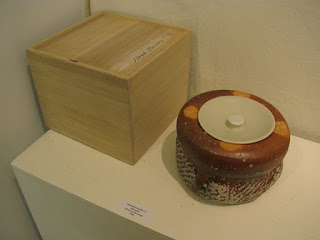
This chawan, featuring his Shino glaze, was fired for 100 hours in the back of the anagama kiln and received little ash. The clay for the body of the mizusashi is also a special mix he uses for tea ware with large grains of feldspar but the contrasting lid is made of porcelain, inspired by the tradition of tea masters who used elegant materials for lids of their rustic pieces, such as Imari porcelain or lacquered wood (as Hank said, "18th century mix-and-match"). He had intended to gild the inside of the lid to prevent it from sliding around on the jar. There are  patches of Shino glaze on the four sides where there is a rope-like texture. He was concerned the porous clay would weep, but we encountered no such problem. 

Hank's pieces were fired in the Jewel Creek Anagama kiln in Sand Lake, Ore., in view of the Pacific Ocean.

We also used some pieces made by Dave Zdrazil, one of the coordinators of West Coast Wood Fire.

Kensui by Dave Zdrazil. He said he was inspired by seeing
kensui at a demonstration we performed last January.

Chawan by Dave Zdrazil. The stripes are created
by different types of clay.

Each guest enjoyed one of Annie's delicious homemade wagashi sweets — sweet mochi wrapped around delicately pink-tinted shiro-an — and a bowl of matcha. Many students brought their own chawan, as a special part of this demonstration was for them to be able to have tea in their own recently-crafted bowls.

Student work

Student work

Later in the evening, we attended two of the three gallery openings of West Coast Wood Fire at the Fire Arts Center and Ironside Gallery, both in Arcata, Calif. (the third gallery is in Eureka at Sewell Gallery). There were so many different and beautiful forms -- vases, cups, jars, decorative pieces and beautiful chawan.The pieces are on exhibit (and for sale!) through the end of March.

Here are Hank Murrow's chawan and mizusashi on display at Fire Arts Center:
 
Tea caddy and chawan by Hank Murrow
Mizusashi by Hank Murrow

For more about Dave, Shannon and Hank's work, visit:

Thursday, March 1, 2012

Nuclear Flowers

Christoph Niemann’s cover illustration,
"Dark Spring," for the March 28, 2011
edition of The New Yorker magazine

 “It’s very tricky to do any drawing of a tragedy,” said Christoph Niemann, who created “Dark Spring,” this week’s cover. When asked to come up with an image about the series of disasters that have hit Japan, he was hesitant. “A drawing often comes across as lighthearted, and there’s obviously nothing lighthearted about this thing.” 

Read the full story at http://www.newyorker.com/online/blogs/newsdesk/2011/03/cover-story-christoph-niemann-japan-earthquake.html

Sunday, February 26, 2012

West Coast Wood Fire Ceramic Artist Exhibitions

UPDATE FEB. 28


March 2- 31 “West Coast Wood Fire”
Fire Arts Center, 520 S. G. Street, Arcata. www.fireartsarcata.com
Opening Reception Friday March 9th, 6-8pm (During Arts! Arcata)
Hours: Monday-Friday 9-5 and by appointment
Phone #: 707-826-1445

Artists include: Mike Beebe (CA,)John Benn (WA), Doug Browe (CA), Rhue Bruggeman (CA), Conrad Calimpong (CA), Richard Carter (CA), Bonita Cohn (CA), Thomas Fossier (CA), Colleen Gallagher (WA), Bill Geisinger (CA), Kathy Guss (WA,)Colinda Gutierrez (CA),Rod Guyer (CA), Chuck Hindes (WA), Sam Hoffman (OR), Richard Hotchkiss (CA), Glenn Husted (CA), Terry Inokuma (OR), Lisa Jetonne (CA), Kathy Kearns (CA), Nils Lou (OR), , Marc Lancet (CA), Diane Levinson (CA), Ron Linn (OR),), Hank Murrow (OR), Fred Olsen (CA), Hiroshi Ogawa (OR),Reid Ozaki (WA), Scott Parady (CA), , Kenneth Pincus (OR), Stephen Robison (WA),Andy Ruble (CA), Monique Rutherford (CA), Steve Sauer (WA), Nick Schwartz (CA), Tim Steele (OR), Jules Stout (CA), Al Tennant (WA), Mark Terry (OR), Mila Visser ‘t Hooft (CA), Jon Weil (CA) , Jay Widmer (OR), David Zdrazil (CA)

The original venue (Plaza Design) for local artists is closing. There are two new venues:

March 1 – April 30 “West Coast Wood Fire Local Artists”
Sewell Gallery, 423 F Street, Eureka. www.sewellgallery.com
Opening Reception Saturday, March 3rd, 6-9 p.m. (During Arts Alive)
Hours: Tuesday – Saturday 10 a.m. – 6 p.m.
            Sunday, Noon – 5 p.m.

March 1 – 30 “West Coast Wood Fire Local Artists”
Ironside Gallery, 900, 9th Street, Arcata. http://ironsidegallery.com/category/home-page/
Opening Reception Friday, March 9th, 6-9 p.m.  (During Arts! Arcata)
Hours: Tuesday- Thursday 11 a.m. – 4 p.m.
            Friday & Saturday 11 a.m. – 7 p.m.

Artists include: Conrad Calimpong, Darcy Casagrande, Honoree Cress, Jessica Eden, Rebecca Degagne, Stephen Faletta, Keith Fleury, Thomas Fossier, Ben Freund, David Jordan, Karl Klingenspor, Peggy Loudon, Matthew Meil, Noel Munn, Scott North, Bob Raymond, Elaine Shore, Shannon Sullivan, Margaret Whitcomb, David Zdrazil

Read more about the exhibits and events at davezdrazil.com/blog/

Saturday, February 25, 2012

Lunar New Year Photos – Finally!

I'm finally posting photos and a video from a Lunar New Year celebration in January. The Multicultural Center of our own Humboldt State University hosted a Lion Dance performance and martial arts demonstrations by the visiting U.S.A. Yau Kung Moon Kung Fu Association of San Francisco. Click here for more photos or watch our YouTube video.

Feeding the lion money for good luck

Kung Fu demonstration